Architecture Overview
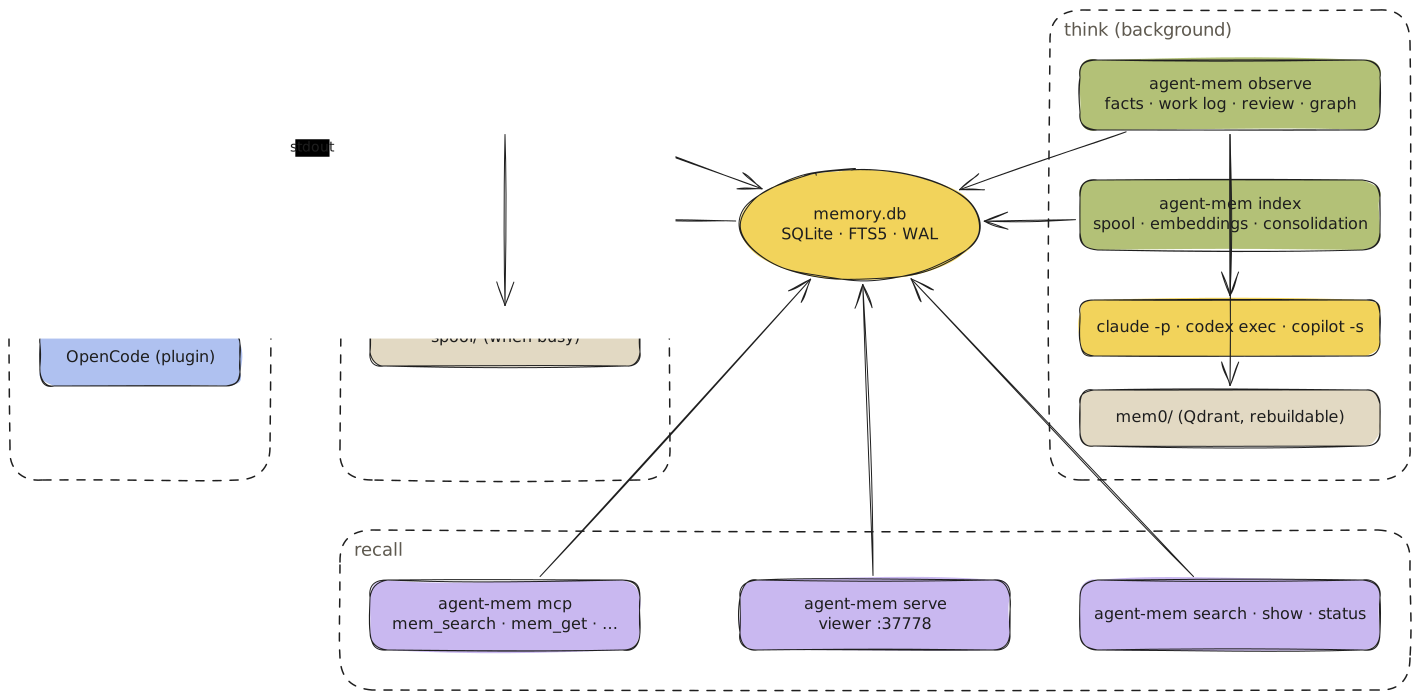
agent-mem has three jobs. It records what coding agents do through their hooks, it thinks about it later in background processes that call the agent’s own CLI, and it recalls what matters, injected into the next session, searchable over MCP and visible in a local viewer. One SQLite file holds all of it.
Components
Section titled “Components”| Component | Command | Runs | Role |
|---|---|---|---|
| Hooks | agent-mem hook <harness> [event] | per event, ~65 ms | record, inject, warn, block; start the rest |
| Observer | agent-mem observe | after requests, until idle | facts, titles, session summary, lessons, review, graph |
| Indexer | agent-mem index | after requests, until done | spool replay, embeddings, notes, token accounting, consolidation, retention |
| MCP server | agent-mem mcp | per agent session | mem_search, mem_timeline, mem_get, mem_remember, mem_forget |
| Viewer | agent-mem serve | always on, port 37778 | a read-only page over the database |
| CLI | agent-mem … | on demand | setup, status, doctor, search, purge, export, … |
Technology
Section titled “Technology”| Layer | Choice | Why |
|---|---|---|
| Language | Python 3.11–3.14 | the hook path uses the standard library only |
| Storage | SQLite (WAL), FTS5 with the trigram tokenizer | one file, concurrent readers, substring search in any language |
| Vectors | fastembed (ONNX Runtime), paraphrase-multilingual-MiniLM-L12-v2, numpy | multilingual, no PyTorch, about 220 MB |
| Fact extraction | mem0 with the agent’s CLI as its model (claude -p, codex exec, copilot -s), optional Ollama | no API key; the vendor that saw a request writes its facts |
| Fact index | Qdrant in local path mode (through mem0) | mem0’s deduplication; rebuildable from SQLite |
| Topic links | spaCy (en_core_web_sm or another language) | mem0’s entity store |
| Time words | dateparser | “letzte Woche”, “8. April”, “last friday” |
| MCP | the official Python MCP SDK, stdio | one process per session |
| Viewer | Python http.server, a self-contained HTML page with its own script | no build step, no network |
| Installer | uv tool | one isolated environment, in-place upgrades |
Data flow
Section titled “Data flow”Recording
Section titled “Recording”- The agent fires an event and runs
agent-mem hook <harness>with the payload on stdin. - The payload is normalized to one
Event, checked (internal, disabled, paused, excluded), cleaned of private sections and secrets, and written in one transaction: session, event, turn, recipes, rules, dead ends. - If the database is busy or the 400 ms deadline passes, the event goes to
spool/instead. - A closed turn is queued in
observe_queue.
Thinking
Section titled “Thinking”Stopstartsagent-mem observe --drain. It leases up to five turns of a session and builds a bundle: prompts, what the tools showed, answers, subagent answers.- The agent’s own CLI extracts facts through mem0; agent-mem mirrors them into
memories. - A second call writes turn titles, the running session summary and lessons.
- Once a day per project the facts are reviewed for duplicates and outdated ones; new memories are read into a graph of things and relations.
agent-mem indexreplays the spool, embeds new text, reads the agents’ own notes, measures token work and runs the daily consolidation.
Recalling
Section titled “Recalling”- Session start: a briefing with your rules and the last session first, within 800 tokens.
- Each prompt: confident matches only, within 2,400 tokens.
- Before a tool: rule notes or a block, and the history of the files it touches.
- After a failure: how this error was fixed before.
- After compaction: session goal, decisions, open failures, files.
- On demand: the MCP tools,
agent-mem search, the viewer.
Session lifecycle
Section titled “Session lifecycle”| Moment | Event | What agent-mem does |
|---|---|---|
| open | SessionStart | briefing, viewer started, panel |
| ask | UserPromptSubmit | close the previous turn, open a new one, learn rules, recall |
| work | PreToolUse / PostToolUse | warn or block, file history, record, fix hints, recipes, dead ends |
| done | Stop | answer stored, turn closed and queued, observer and indexer started |
| compact | PreCompact / SessionStart(compact) | the compaction block |
| close | SessionEnd | last turn closed, summary line |
Code layout
Section titled “Code layout”src/agent_mem/ core/ config, db + schema/, events, identity, privacy, signals, spool, timeutil, logutil, paths standard library only; shared by every path hooks/ hook (entry point), normalize/ (claude, codex, copilot, opencode), capture, inject the hook path: payload in, SQLite write, context out; standard library only memory/ store, search, semantic, learn, consolidate, views, indexer, notes, work memories, retrieval, embeddings, learning, the background indexer observe/ queue, bundle, providers, mem0_adapter, summary, review, relations, worker, spacy_model, coding_instructions.md — the only place that imports mem0 and Qdrant mcp/ server: the stdio MCP server cli/ argument parsing, commands, install (setup --write, uninstall), health (status, doctor) ui/ the self-contained page and the loopback server bench/ evaluate: fixture and LongMemEval-S runner (not used at runtime)plugins/ claude, codex, copilot, opencode: hook files, manifests, the OpenCode pluginDependencies point one way: core ← hooks, memory ← observe, mcp, ui, bench ← cli. Nothing in
core, hooks or memory imports from observe, cli or ui. A test checks that the hook path never imports
mem0, Qdrant, fastembed or numpy.
Guarantees
Section titled “Guarantees”- The agent is never blocked or broken. Every hook exits 0 and prints valid output or nothing.
- No event is lost. Busy database, migration or deadline: the event waits in the spool and is replayed in order.
- No turn is lost. It stays in
observe_queueuntil facts are extracted or it is stored word for word; failures back off and end infailed, retryable. - A request stays with its vendor. A Claude Code turn goes to Claude, a Codex turn to Codex, a Copilot turn to
Copilot, unless you set
observe.cross_vendor. - SQLite is the truth. Everything in
mem0/can be rebuilt from it without a model call. - Nothing leaves the machine except model downloads and your agent’s own CLI talking to its own provider.
Deeper
Section titled “Deeper”How agent-mem uses hooksWhy hooks, how they are launched, each event, timing, failure modes, debugging.
Hook LifecyclePayloads and outputs per agent, sequence diagrams, state machines.
Observer PipelineQueue, bundles, providers, extraction, work log, review, graph.
DatabaseEvery table, the FTS5 index, migrations, retention.
Search ArchitectureCandidates, fusion, scoring, abstention, the five MCP tools.
Context InjectionEvery block, its budget and how it is chosen.