Learning & Ranking
Facts need a model (the observer). Everything on this page needs none. It is counted from what the hooks see, in plain SQL, on the hook path or in the daily consolidation.
Activation (ACT-R)
Section titled “Activation (ACT-R)”Memories used often and recently rank higher. Unused ones fade, but nothing is deleted for being old.
B = ln Σ_j max(t_j, 1) ^ -0.5 t_j = hours since retrieval j (the newest 20 exactly, older ones approximated with the age of the oldest of those 20)activation_factor = 0.5 + 0.5 · σ(B) σ = logistic function; a memory never retrieved gets B = -10 → 0.5What counts as a retrieval: created, get, used, cited. What does not: shown and injected. An
injection is an exposure. Counted as a retrieval, it would raise the activation of whatever was injected and
make it injected again, so the briefing would feed itself.
| Hours since one retrieval | t^-0.5 | B | factor |
|---|---|---|---|
| ≤ 1 | 1.00 | 0.00 | 0.75 |
| 24 | 0.20 | −1.59 | 0.58 |
| 168 (a week) | 0.077 | −2.56 | 0.54 |
| five retrievals within the last hour | 5.00 | 1.61 | 0.92 |
Usefulness (implicit feedback)
Section titled “Usefulness (implicit feedback)”usefulness = (used + 1) / (shown + 2) Laplace-smoothed, neutral 0.5usefulness_factor = 0.5 + usefulness 0.5 … 1.5, used in every search scorebriefing_factor = 0.5 + (used + 1) / (injected + 2) used for the session-start briefingA memory counts as used when the agent:
| Signal | Access kind | Recorded by |
|---|---|---|
opens it with mem_get | get | memory/views.details |
| edits a file the memory is linked to, after it was shown or injected this session | used | capture._feedback_used |
writes its id (T12, M3) in the final answer | cited | capture._on_stop |
A memory injected at many session starts and never used makes room for something else (briefing_factor falls
toward 0.5). One shown for every prompt and never opened sinks in search.
Importance and trust
Section titled “Importance and trust”importance (0–1) is set when a row is written and only goes up:
| Event | Importance |
|---|---|
| a read | 0.1 |
| a command | 0.3 |
| an edit, a test | 0.5 |
| an error, a long answer (over 200 characters) | 0.6 |
| a decision, a dead end, a commit | 0.7 |
| a correction | 0.8 |
| a lesson | 0.8 |
| an extracted rule (preference) | 0.85 |
| a fix (a failing command passed again) | 0.9 |
| a preference stated in two projects (global) | 0.9 |
In a score it counts as 0.7 + 0.3 · importance, so it never dominates.
trust says who wrote the text: user (1.0, what you typed), agent (0.9, mem_remember, imported notes),
observer (0.8, extracted facts), tool_local (0.8), tool_external (0.5, web pages, third-party MCP servers),
raw (0.8, a turn kept word for word).
Corrections become rules
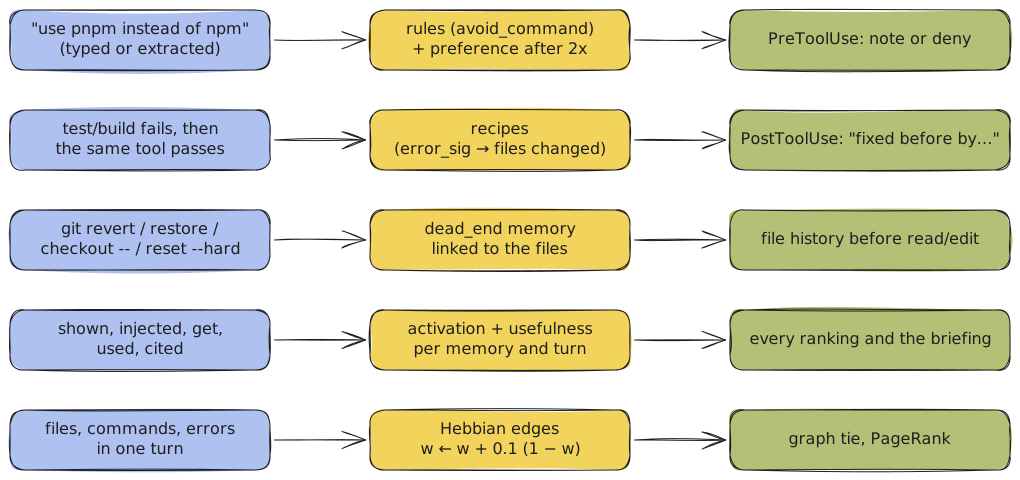
Section titled “Corrections become rules”you type: "Use pnpm instead of npm" → rules(kind='avoid_command', pattern='npm', message='Use `pnpm` instead of `npm`', evidence=1, enabled=0)again: evidence = 2 = rules.min_corrections → memories(kind='preference', title='Use `pnpm` instead of `npm` (corrected 2x)', trust='user', importance 0.85) → with rules.auto_enable: enabled = 1| Rule state | Before npm install |
|---|---|
suggested (enabled = 0, default) | a note: - Note (R1): earlier correction — Use pnpm instead of npm (1x). |
enabled (agent-mem rules enable 1 or rules.auto_enable) | the call is denied: agent-mem rule R1: Use pnpm instead of npm (you were corrected 2x). |
The statements agent-mem recognizes in a prompt you typed:
| Pattern | Example | Rule |
|---|---|---|
use / nutze / verwende / benutze / nimm X instead of / statt / anstatt / anstelle von / not Y | use pnpm instead of npm | avoid npm, prefer pnpm |
X statt / anstatt Y (short, or with backticks) | `uv` statt `pip` | avoid pip, prefer uv | |
nicht / kein / not / no X [benutzen], sondern / but / use Y | nicht pip benutzen, sondern uv | avoid pip, prefer uv |
never use / don't use / do not use / nie / niemals / kein / keine / nicht X | never use yarn | avoid yarn (no preferred tool) |
A bare X statt Y inside a long sentence without backticks is ignored: “Redo anstatt Reuse zu nennen” is a word
swap, not a tool rule.
Rules for counting:
- One turn is one statement. The prompt hook and later the observer read the same prompt; counted twice, a
sentence typed once would become a preference. The key
rule.turn|<project>|<avoid>|<prefer>|<turn>inmetamakes each count unique. - The newer statement wins. “Use npm instead of pnpm” after “use pnpm instead of npm” disables the old rule and retires its preference; with both on, npm and pnpm would both be blocked.
- Only your words. A rule extracted by the observer is created only if both tool names appear in what you typed, not just in a README the agent read.
- A rule matches programs, not substrings. The command is split at
&&,||,;and|, redirects and leadingVAR=valueassignments are removed, and the rule’s pattern is compared with the programs that run. - Overrides. Typing
trotzdem,egal,anyway,do it anyway,ignore the ruleormach es trotzdemwithin 15 minutes after a rule fired counts as an override; the second override switches the rule off. - Expiry. An enabled rule that has not fired for
rules.expire_days(90) is switched off by the daily consolidation.
Manage rules with agent-mem rules list|enable|disable|delete <id>.
Errors become recipes
Section titled “Errors become recipes”When a test, build, lint or install command fails and the same tool later passes in the session, agent-mem records an error-to-fix recipe:
| Column | Example |
|---|---|
error_sig | hash of the normalized error (paths, numbers, hex ids, quoted names removed) |
error_text | E ImportError: cannot import name 'subtract' from 'calc' (calc.py) |
command_key | uv run pytest |
files_json | ["calc.py"], the files edited between the failure and the pass |
successes, recurrences | how often it was fixed, how often it came back |
The next failure with the same signature gets This error was seen before with uv run pytest and fixed by changing calc.py (see T1). Seen 1x, fixed 1x. A failed cat, grep or ls is looking around and never makes a recipe; a
non-zero exit without an error line (grep with no match) is not an error that was fixed. The daily consolidation
drops recipes that slipped through from older releases.
Reverts become dead ends
Section titled “Reverts become dead ends”A successful git revert, git restore, git checkout -- <file> or git reset --hard turns the session’s
reverted edits into a dead_end memory linked to those files:
Changes to calc.py were reverted (`git checkout`) — context: Make subtract accept stringsBefore the next read or edit of calc.py in any session, the file history shows it first, labelled Caution.
The association graph
Section titled “The association graph”Every finished turn links its files, the working part of its commands (uv run pytest, not the whole line),
its error lines and error signatures as entities. Entities of one turn are connected pairwise with a
Hebbian update:
w ← w + 0.1 · (1 − w) per co-occurrence, at most 12 entities (66 pairs) per turnw ← w · 0.5 ^ (days / 60) decay in the daily consolidation; edges under 0.05 are removedAt search time, entities named in the query seed a Personalized PageRank (restart probability 0.5,
30 iterations) over the project’s edges; the top 30 nodes and the seeds weight the memories and turns linked to
them. Frequent “hub” entities (a test command in every turn) are damped like IDF:
weight / (1 + ln(1 + degree)), and only their 50 newest links are read. The graph reorders hits that text and
vectors found (× (1 + 0.3 · tie)); it adds no candidates of its own.
Separately, the observer reads memories into a typed graph of concepts and relations (“search.py uses SQLite FTS5”) that the viewer draws. See Observer Pipeline.
Daily consolidation
Section titled “Daily consolidation”The indexer runs this at most once per 24 hours (meta.consolidated_at):
| Step | What |
|---|---|
| 1 | decay and prune Hebbian edges |
| 2 | a preference you stated in two or more projects becomes a global preference (across projects), importance 0.9; it is withdrawn when the projects take it back |
| 3 | of facts, decisions and summaries with the same normalized title in a project, the newest wins |
| 4 | enabled rules unused for rules.expire_days are switched off |
| 5 | recorded commands keep only their reusable part (… 2>&1 | tail; git status → uv run pytest -q) |
| 6 | recipes whose “error” is no error are dropped |
| 7 | entities that are whole command lines or scratch files are merged into their working part or removed |
| 8 | git blob hashes are recorded for linked files (anchors) |
| 9 | a dead end or decision whose every anchored file was deleted is retired |
| 10 | with vectors: new memories add related: <title> as a search key to up to four neighbours with cosine ≥ 0.85 in the same project |
The vector side also retires an older observer or agent memory when a newer one of the same project says the same
thing (cosine ≥ semantic.duplicate_min_cosine, 0.90). What you wrote is never retired this way.
Where it all meets
Section titled “Where it all meets”search score = rrf_norm × activation_factor × (0.7 + 0.3 · importance) × usefulness_factor × trust × project_boostbriefing = activation_factor × briefing_factor × (0.7 + 0.3 · importance) × kind priority kind priority: preference 1.3 · dead_end 1.25 · decision 1.2 · correction 1.1 · lesson 1.1 · other 1.0See Search Architecture and Context Injection.