Database
SQLite is the truth. Everything agent-mem knows is in one file, memory.db; everything in mem0/ can be rebuilt
from it without a model call.
Location
Section titled “Location”| OS | Data folder |
|---|---|
| macOS | ~/Library/Application Support/agent-mem/ |
| Linux | $XDG_DATA_HOME/agent-mem/, else ~/.local/share/agent-mem/ |
| Windows | %LOCALAPPDATA%\agent-mem\ |
AGENT_MEM_DATA_DIR overrides it, and agent-mem paths prints it. The folder is 0700 and the database 0600 on
macOS and Linux.
Connection
Section titled “Connection”PRAGMA busy_timeout = 150; -- hooks; the MCP server 2,000; indexer 5,000; observer 10,000PRAGMA foreign_keys = ON;PRAGMA journal_mode = WAL; -- readers never wait for a writerPRAGMA synchronous = NORMAL;PRAGMA journal_size_limit = 4194304; -- the WAL shrinks back to 4 MB after a large writeWrites run in BEGIN IMMEDIATE transactions, so two writers queue at the start rather than fail at commit. A hook
waits at most 150 ms for the write lock. After that the event goes to the spool, well inside the 400 ms deadline.
Claude Code, Codex, Copilot and OpenCode can run at the same time in the same project; their writes are
serialized by SQLite.
Tables
Section titled “Tables”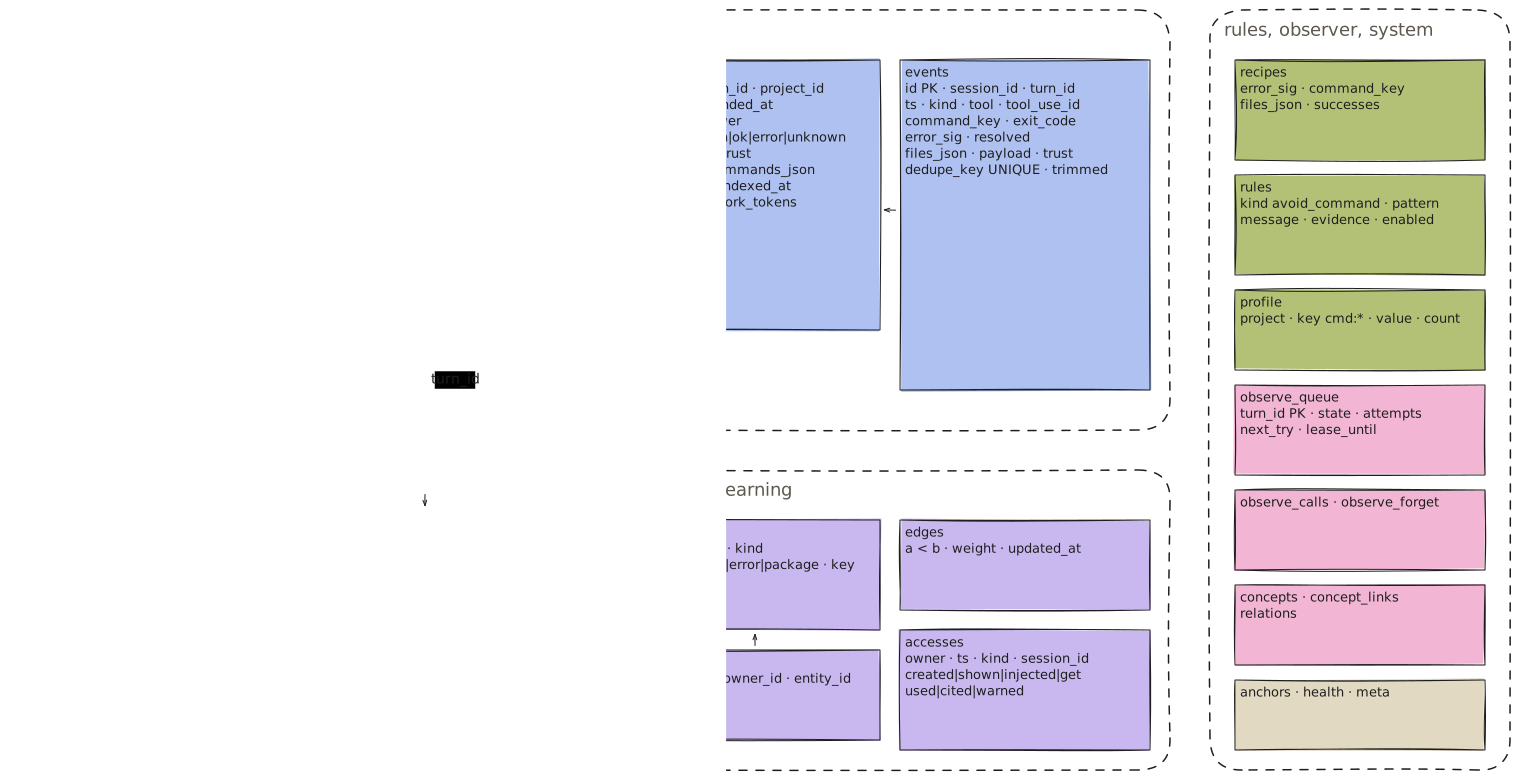
Owners are addressed as (owner_type, owner_id): 't' is a turn, 'm' a memory. Everything visible uses that
as T12 and M3.
projects, project_paths
Section titled “projects, project_paths”CREATE TABLE projects ( id TEXT PRIMARY KEY, -- first 16 hex of sha256(remote | root commit | path) remote TEXT, -- normalized: github.com/me/app name TEXT NOT NULL, root TEXT NOT NULL, created_at TEXT NOT NULL);CREATE TABLE project_paths ( path TEXT PRIMARY KEY, -- every folder seen, so git is asked only once project_id TEXT NOT NULL REFERENCES projects(id) ON DELETE CASCADE);See Capture & Privacy.
sessions
Section titled “sessions”CREATE TABLE sessions ( id TEXT PRIMARY KEY, -- '<harness>:<native session id>' harness TEXT NOT NULL, -- claude | codex | copilot | opencode native_id TEXT NOT NULL, project_id TEXT REFERENCES projects(id) ON DELETE CASCADE, branch TEXT, started_at TEXT NOT NULL, ended_at TEXT, last_event_at TEXT NOT NULL, summarized_at TEXT, title TEXT, -- v3: the observer's session title summary_json TEXT -- v3: {"learned": [...], "completed": [...], "next_steps": [...]});CREATE INDEX sessions_project ON sessions(project_id, last_event_at);One request and everything done for it, from the prompt to the answer.
CREATE TABLE turns ( id INTEGER PRIMARY KEY, session_id TEXT NOT NULL REFERENCES sessions(id) ON DELETE CASCADE, project_id TEXT REFERENCES projects(id) ON DELETE CASCADE, started_at TEXT NOT NULL, ended_at TEXT, prompt TEXT NOT NULL DEFAULT '', answer TEXT NOT NULL DEFAULT '', outcome TEXT NOT NULL DEFAULT 'open' CHECK (outcome IN ('open', 'ok', 'error', 'unknown')), importance REAL NOT NULL DEFAULT 0.1, trust TEXT NOT NULL DEFAULT 'user', files_json TEXT NOT NULL DEFAULT '[]', -- read and edited, relative to the project, up to 40 commands_json TEXT NOT NULL DEFAULT '[]', -- up to 40 errors_json TEXT NOT NULL DEFAULT '[]', -- first error lines, up to 10 indexed_at TEXT, title TEXT, -- v3: ≤ 80 characters, by the observer type TEXT, -- v3: bugfix | feature | change | discovery | decision | question work_tokens INTEGER -- v6: tokens the agent spent, from its transcript);CREATE INDEX turns_session ON turns(session_id, id);CREATE INDEX turns_project ON turns(project_id, started_at);CREATE INDEX turns_open ON turns(outcome, started_at);events
Section titled “events”Every hook call that passed the checks, once.
CREATE TABLE events ( id INTEGER PRIMARY KEY, session_id TEXT NOT NULL REFERENCES sessions(id) ON DELETE CASCADE, turn_id INTEGER REFERENCES turns(id) ON DELETE CASCADE, ts TEXT NOT NULL, kind TEXT NOT NULL, -- session_start | prompt | pre_tool | tool | stop | subagent_stop | compact | session_end tool TEXT, tool_use_id TEXT, command_key TEXT, -- 'uv run pytest' exit_code INTEGER, error_sig TEXT, resolved INTEGER NOT NULL DEFAULT 0, files_json TEXT NOT NULL DEFAULT '[]', payload TEXT NOT NULL, -- JSON, cleaned; trimmed after retention.payload_days trust TEXT NOT NULL, -- user | tool_local | tool_external dedupe_key TEXT NOT NULL UNIQUE, trimmed INTEGER NOT NULL DEFAULT 0);CREATE INDEX events_turn ON events(turn_id);CREATE INDEX events_session_failures ON events(session_id, command_key, resolved) WHERE error_sig IS NOT NULL;CREATE INDEX events_ts ON events(ts);CREATE INDEX events_session_ts ON events(session_id, ts); -- v8events_session_ts exists for one query on the hook path: finding the session’s edits since a failure when the
command passes again. Without it, that query read the events of every session in the time window.
memories
Section titled “memories”Append-only knowledge: facts, decisions, rules, lessons, notes.
CREATE TABLE memories ( id INTEGER PRIMARY KEY, project_id TEXT REFERENCES projects(id) ON DELETE CASCADE, -- NULL = global kind TEXT NOT NULL CHECK (kind IN ( 'summary', 'fact', 'decision', 'dead_end', 'preference', 'correction', 'lesson', 'native_note' )), title TEXT NOT NULL, -- ≤ 300 body TEXT NOT NULL, -- ≤ 8,000 source TEXT NOT NULL CHECK (source IN ('hook', 'agent', 'native', 'harness_summary', 'import')), trust TEXT NOT NULL, -- user | agent | observer | raw importance REAL NOT NULL DEFAULT 0.5, turn_id INTEGER REFERENCES turns(id) ON DELETE SET NULL, origin TEXT, -- the harness, or claude-auto-memory / codex-memory for native notes valid_from TEXT NOT NULL, invalid_at TEXT, -- set when retired; the row stays superseded_by INTEGER REFERENCES memories(id) ON DELETE SET NULL, created_at TEXT NOT NULL, dedupe_key TEXT UNIQUE);CREATE INDEX memories_project ON memories(project_id, kind, invalid_at);CREATE INDEX memories_turn ON memories(turn_id); -- v6| kind | Written by | source / trust |
|---|---|---|
fact, decision, dead_end | observer extraction | agent / observer |
preference | observer [rule]; two corrections of the same rule | agent / observer; hook / user |
lesson | observer work log | agent / observer |
correction, decision | prompt hook without a working observer | hook / user |
dead_end | a revert after edits | hook / agent |
fact, decision, dead_end, lesson | mem_remember | agent / agent |
summary | a turn no model could take | hook / raw |
native_note | Claude Code memory/*.md, Codex rollout summaries | native / agent |
| dedupe_key | Meaning |
|---|---|
mem0:<id> | mirrored from mem0 |
lesson:<sha256> | lesson text, normalized |
pref|<project>|<avoid>|<count> | preference from corrections |
global-pref|<text>|<id> | preference promoted to all projects |
raw:<first>-<last> | turns stored word for word |
note:<source>:<hash> | a native note version |
| otherwise | sha256 of project, kind, title and body |
Retiring a memory (store.supersede) sets invalid_at and superseded_by, removes its search keys and vector,
and queues its mem0 copy for removal. Search never returns it; agent-mem show and the viewer still do.
search_keys, search_fts
Section titled “search_keys, search_fts”CREATE TABLE search_keys ( id INTEGER PRIMARY KEY, owner_type TEXT NOT NULL, owner_id INTEGER NOT NULL);CREATE INDEX search_keys_owner ON search_keys(owner_type, owner_id);
CREATE VIRTUAL TABLE search_fts USING fts5(text, tokenize = 'trigram');One owner can have several keys: its own text plus related: <title> keys added by consolidation. A turn’s key is
[<harness> · <branch> · <day>], prompt, answer, files: (paths and file names), commands: and errors:; a
memory’s is <kind>: <title> and its body; each is capped at 12,000 characters. The trigram tokenizer makes
every substring of three or more characters searchable, in any language, so a stem matches all its forms. Queries
quote every term and double embedded "; FTS syntax from a user cannot get through.
vectors
Section titled “vectors”CREATE TABLE vectors ( owner_type TEXT NOT NULL, owner_id INTEGER NOT NULL, model TEXT NOT NULL, -- the embedder that made it vec BLOB NOT NULL, -- float32, normalized PRIMARY KEY (owner_type, owner_id));One vector per owner, upserted. Changing semantic.model re-embeds everything on the next indexer run (up to
100,000 at once instead of 512).
entities, links, edges
Section titled “entities, links, edges”CREATE TABLE entities ( id INTEGER PRIMARY KEY, project_id TEXT, kind TEXT NOT NULL CHECK (kind IN ('file', 'command', 'error', 'package')), key TEXT NOT NULL, -- 'calc.py', 'uv run pytest', 'sig:7c57…', 'left-pad' UNIQUE (project_id, kind, key));CREATE TABLE links ( owner_type TEXT NOT NULL, owner_id INTEGER NOT NULL, entity_id INTEGER NOT NULL REFERENCES entities(id) ON DELETE CASCADE, PRIMARY KEY (owner_type, owner_id, entity_id));CREATE INDEX links_entity_owner ON links(entity_id, owner_id);CREATE TABLE edges ( a INTEGER NOT NULL REFERENCES entities(id) ON DELETE CASCADE, b INTEGER NOT NULL REFERENCES entities(id) ON DELETE CASCADE, weight REAL NOT NULL, -- Hebbian, 0..1 updated_at TEXT NOT NULL, PRIMARY KEY (a, b), CHECK (a < b));CREATE INDEX edges_b ON edges(b);anchors
Section titled “anchors”CREATE TABLE anchors ( owner_type TEXT NOT NULL, owner_id INTEGER NOT NULL, path TEXT NOT NULL, blob_hash TEXT, -- git hash-object of the file when recorded recorded_at TEXT NOT NULL, PRIMARY KEY (owner_type, owner_id, path));Consolidation records the blob hash of each linked file (up to 2,000 per run). mem_get compares it with the
file now: unchanged, changed since <day> or deleted. A dead end or decision whose every anchored file was
deleted is retired.
accesses
Section titled “accesses”CREATE TABLE accesses ( id INTEGER PRIMARY KEY, owner_type TEXT NOT NULL, owner_id INTEGER NOT NULL, ts TEXT NOT NULL, kind TEXT NOT NULL CHECK (kind IN ('created', 'shown', 'injected', 'get', 'used', 'cited', 'warned')), session_id TEXT);CREATE INDEX accesses_owner ON accesses(owner_type, owner_id, ts);CREATE INDEX accesses_session ON accesses(session_id, kind, ts);The basis of activation and usefulness, see Learning & Ranking.
recipes, rules, profile
Section titled “recipes, rules, profile”CREATE TABLE recipes ( id INTEGER PRIMARY KEY, project_id TEXT REFERENCES projects(id) ON DELETE CASCADE, error_sig TEXT NOT NULL, error_text TEXT NOT NULL, command_key TEXT NOT NULL, files_json TEXT NOT NULL, -- files changed between failure and pass successes INTEGER NOT NULL DEFAULT 1, recurrences INTEGER NOT NULL DEFAULT 0, last_turn_id INTEGER, updated_at TEXT NOT NULL, UNIQUE (project_id, error_sig, command_key));CREATE TABLE rules ( id INTEGER PRIMARY KEY, -- R<n> project_id TEXT REFERENCES projects(id) ON DELETE CASCADE, kind TEXT NOT NULL CHECK (kind IN ('avoid_command')), pattern TEXT NOT NULL, -- the program to avoid: 'npm' message TEXT NOT NULL, -- 'Use `pnpm` instead of `npm`' evidence INTEGER NOT NULL DEFAULT 1, -- corrections that stated it enabled INTEGER NOT NULL DEFAULT 0, -- 1 = deny the tool call hits INTEGER NOT NULL DEFAULT 0, overrides INTEGER NOT NULL DEFAULT 0, created_at TEXT NOT NULL, last_hit_at TEXT, UNIQUE (project_id, kind, pattern));CREATE TABLE profile ( project_id TEXT NOT NULL REFERENCES projects(id) ON DELETE CASCADE, key TEXT NOT NULL, -- cmd:test | cmd:build | cmd:lint | cmd:install value TEXT NOT NULL, -- 'uv run pytest -q' count INTEGER NOT NULL DEFAULT 1, updated_at TEXT NOT NULL, PRIMARY KEY (project_id, key, value));observe_queue, observe_calls, observe_forget
Section titled “observe_queue, observe_calls, observe_forget”CREATE TABLE observe_queue ( turn_id INTEGER PRIMARY KEY REFERENCES turns(id) ON DELETE CASCADE, state TEXT NOT NULL DEFAULT 'pending' CHECK (state IN ('pending', 'running', 'done', 'raw', 'failed')), attempts INTEGER NOT NULL DEFAULT 0, next_try TEXT NOT NULL, lease_until TEXT, provider TEXT, -- the stage that took it last_error TEXT, updated_at TEXT NOT NULL);CREATE INDEX observe_queue_state ON observe_queue(state, next_try);
CREATE TABLE observe_calls ( -- every model call; never the prompt text id INTEGER PRIMARY KEY, ts TEXT NOT NULL, provider TEXT NOT NULL, purpose TEXT NOT NULL CHECK (purpose IN ('extract', 'judge', 'summary', 'review', 'graph')), seconds REAL NOT NULL, ok INTEGER NOT NULL, prompt_chars INTEGER NOT NULL, turn_ids TEXT NOT NULL, error TEXT);CREATE INDEX observe_calls_ts ON observe_calls(ts);
CREATE TABLE observe_forget ( -- mem0 ids whose copy still has to go mem0_id TEXT PRIMARY KEY, ts TEXT NOT NULL);The hook path and the MCP server never import mem0. They leave an id in observe_forget, and the next observer
run deletes it from Qdrant, the entity store and history.db.
concepts, concept_links, relations
Section titled “concepts, concept_links, relations”CREATE TABLE concepts ( id INTEGER PRIMARY KEY, project_id TEXT NOT NULL, key TEXT NOT NULL, -- 'inject.py' for inject.py, `inject.py`, src/…/inject.py, Inject.py label TEXT NOT NULL, type TEXT NOT NULL, -- file | function | module | tool | library | command | setting | error | service | concept specific INTEGER NOT NULL DEFAULT 1, UNIQUE (project_id, key));CREATE TABLE concept_links ( concept_id INTEGER NOT NULL REFERENCES concepts(id) ON DELETE CASCADE, memory_id INTEGER NOT NULL REFERENCES memories(id) ON DELETE CASCADE, PRIMARY KEY (concept_id, memory_id));CREATE TABLE relations ( id INTEGER PRIMARY KEY, project_id TEXT NOT NULL, source_id INTEGER NOT NULL REFERENCES concepts(id) ON DELETE CASCADE, target_id INTEGER NOT NULL REFERENCES concepts(id) ON DELETE CASCADE, type TEXT NOT NULL, -- uses | calls | imports | reads | writes | stores_in | configures | depends_on | … memory_id INTEGER NOT NULL REFERENCES memories(id) ON DELETE CASCADE, UNIQUE (source_id, target_id, type, memory_id));The viewer’s Graph page. A concept no memory names any more is deleted with its last memory.
health, meta
Section titled “health, meta”CREATE TABLE health ( component TEXT PRIMARY KEY, -- hook:claude | hook:codex | hook:copilot | hook:opencode | indexer | semantic | observer | consolidation last_ok_at TEXT, last_error_at TEXT, last_error TEXT, ok_count INTEGER NOT NULL DEFAULT 0, error_count INTEGER NOT NULL DEFAULT 0);CREATE TABLE meta (key TEXT PRIMARY KEY, value TEXT NOT NULL);A component is failing when last_error_at is newer than last_ok_at. Its message then appears at session start
and in doctor.
| meta key | Holds |
|---|---|
paused_until | ISO time or forever (agent-mem pause) |
indexer_spawned_at | throttle for starting the indexer |
consolidated_at, vacuumed_at | last consolidation, last VACUUM |
semantic | the embedder in use, or unavailable |
duplicates.last_memory_id | where the duplicate merge continues |
observe.embedder | embedder of the mem0 index; a change triggers a rebuild |
observe.pause.<provider>, observe.pause_kind.<provider> | a paused stage and why (quota, login) |
observe.graph_hold | graph batches paused until |
observe.scrub_messages | 1 after a turn was deleted: clear mem0’s message history |
reviewed_at:<project>, review_cursor:<project> | daily review time and its rotating slice |
graph.last:<project> | where the graph reading continues |
injected:<day> | blocks, tokens and measured work injected that day |
work.offset:<transcript> | how far a transcript has been read for token accounting |
rule.turn|<project>|<avoid>|<prefer>|<turn> | one statement counted once |
Migrations
Section titled “Migrations”PRAGMA user_version holds the schema version. Migrations are the numbered files in core/schema/:
| Version | File | Change |
|---|---|---|
| 1 | 001_init.sql | base schema |
| 2 | 002_observe.sql | observe_queue, observe_calls, observe_forget |
| 3 | 003_summaries.sql | turns.title, turns.type, sessions.title, sessions.summary_json |
| 4 | 004_observe_purposes.sql | observe_calls.purpose allows summary, review (table copied: SQLite cannot change a CHECK) |
| 5 | 005_concepts.sql | concepts, concept_links |
| 6 | 006_work_tokens.sql | turns.work_tokens, index memories_turn |
| 7 | 007_relations.sql | relations; old spaCy concepts cleared; purpose graph |
| 8 | 008_events_session.sql | index events_session_ts |
All pending migrations run in one BEGIN EXCLUSIVE transaction and either all apply or none. ADD COLUMN
for a column that already exists is skipped. The hook path never migrates an existing database: a migration
of a large file could outlast its deadline. It raises MigrationPendingError, spools the event and starts the
indexer, which migrates and then replays the spool. A database written by a newer release raises
SchemaTooNewError instead of being touched.
Integrity and recovery
Section titled “Integrity and recovery”Each indexer run first opens the database read-only and runs PRAGMA quick_check. Read-only matters: a
writable connection checkpoints and deletes the WAL when it closes, even on a damaged file. A locked or busy
database is not damage. If the check fails, memory.db, -wal and -shm are moved aside as
memory.db.corrupt-<time> and a fresh database starts. The WAL holds committed writes and is kept for a manual
rescue; nothing is deleted.
Retention
Section titled “Retention”| What | When | Key |
|---|---|---|
event payloads trimmed to raw_kind, category, error_line, trust | after 30 days | retention.payload_days |
shown, warned, injected accesses deleted | after 180 days | retention.access_days |
observe_calls rows deleted | after 180 days | retention.access_days |
| quarantine notes deleted | after 30 days | retention.payload_days |
the 5,000 oldest untrimmed payloads trimmed, then VACUUM | above 1,024 MB, at most once a day | retention.max_db_mb |
open turns closed as unknown | 30 minutes without activity | retention.stale_turn_minutes |
Turns, memories, rules and recipes are never deleted by age. agent-mem purge deletes on request.
Next to the database: mem0/
Section titled “Next to the database: mem0/”| Path | What | Rebuilt by |
|---|---|---|
mem0/qdrant/ | Qdrant in local path mode, collection agent_mem, one namespace per project (user_id = <OS user>|p:<project id>) | agent-mem observe --reindex |
collection agent_mem_entities | mem0’s entity store (spaCy) | same |
mem0/history.db | mem0’s add log; holds bundle messages, so purge and --reindex delete it | same |
Embeddings in Qdrant and in vectors come from the same embedder, so both indexes agree.