Background Processes
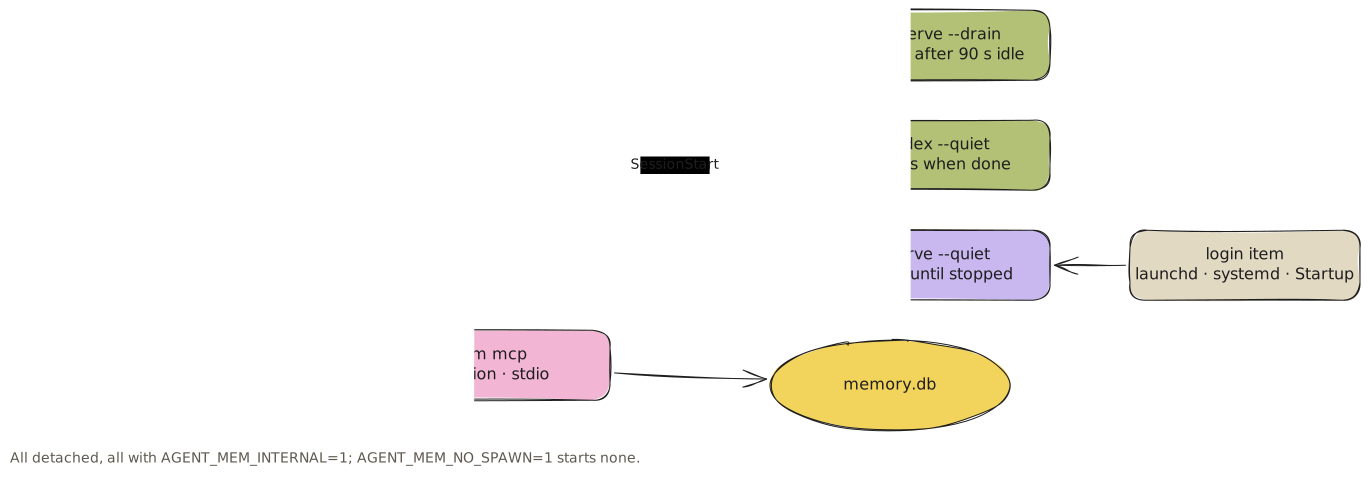
agent-mem has no daemon to install and no service to keep alive. The hook starts short-lived background processes when there is work. One small web server, the viewer, stays up so the page is reachable.
| Process | Started by | Lifetime | Guard | Priority |
|---|---|---|---|---|
agent-mem hook <harness> | the agent, per event | ~65 ms | 400 ms deadline | normal |
agent-mem mcp | the agent, per session | the session | one SQLite connection, calls serialized | normal |
agent-mem observe --drain --quiet | Stop, SessionEnd, the indexer | until 90 s without work | observe.lock, 15 s spawn throttle | nice 10 |
agent-mem index --quiet | Stop, SessionEnd, a waiting spool, a pending migration | until its work is done | indexer.lock, 60 s spawn throttle | normal |
agent-mem serve --quiet | SessionStart when the port is silent; the login item | until stopped | the port | background |
Every process agent-mem starts is detached from the agent (start_new_session, or DETACHED_PROCESS | CREATE_NEW_PROCESS_GROUP | CREATE_NO_WINDOW on Windows), has stdin, stdout and stderr closed, and runs with
AGENT_MEM_INTERNAL=1 and AGENT_MEM_DATA_DIR set. Its own work is never recorded, and it uses the same data
folder as the hook that started it. AGENT_MEM_NO_SPAWN=1 stops the hook from starting anything.
agent-mem observe
Section titled “agent-mem observe”The observer turns finished requests into facts with the agent’s own CLI. All details are on Observer Pipeline.
$ agent-mem observe --statusRequests: 42 waiting, 0 with facts, 0 saved word for word, 0 failed| Option | Does |
|---|---|
| (none) | one pass over what is due, then review and graph |
--drain | loop until nothing was due for observe.idle_seconds (what the hook starts) |
--once | process what is due and exit without waiting |
--status | queue counts, last errors, today’s calls per provider and purpose (--json for all) |
--retry-failed | failed turns back to pending with zero attempts, then a pass |
--reprocess-raw | turns stored word for word go back to the queue (after installing a CLI) |
--reindex | rebuild Qdrant, the entity store and history.db from SQLite, no model call |
--quiet | no output |
A second observer while one runs returns at once: skipped: locked.
agent-mem index
Section titled “agent-mem index”The indexer does everything the hook leaves for later, in this order:
| # | Step | Note |
|---|---|---|
| 1 | integrity check | read-only PRAGMA quick_check; a damaged file is moved aside as memory.db.corrupt-<time> |
| 2 | migrations | when the schema is behind; all in one exclusive transaction |
| 3 | spool replay | in file-name order (nanosecond time first); a record that can never apply goes to quarantine/ |
| 4 | stale turns | open turns without activity for retention.stale_turn_minutes are closed as unknown |
| 5 | token accounting | turns.work_tokens from the agents’ transcripts (Token Accounting) |
| 6 | native notes | Claude Code memory/*.md, Codex rollout summaries (below) |
| 7 | retired keys | search keys and vectors of retired memories are removed |
| 8 | project aliases | a project first seen before its first commit or remote stays the same project |
| 9 | guards file | guards.json: whether any rule exists and which files have history, so PreToolUse can skip the database |
| 10 | embeddings | up to 512 new turns and memories (all of them after a model change); duplicate facts merged |
| 11 | consolidation | once per 24 h (Learning & Ranking) |
| 12 | retention | payload trimming, access and call log cleanup, VACUUM above retention.max_db_mb |
| 13 | spool again | up to 5 more passes for events that arrived meanwhile |
| 14 | observer | started if the replay or stale turns queued work |
| 15 | PRAGMA optimize, WAL checkpoint (passive) |
agent-mem index runs it by hand. --no-download skips fetching the search model, --json prints the stats. A
second indexer returns skipped: another indexer is running. A database held by another process longer than 5 s
is not an error; the run stops and the spool waits for the next one.
The spool
Section titled “The spool”Events that cannot reach the database right now wait in spool/, one small JSON file each:
spool/01760385174362715000-12734-3c8297d3e1a0-9f2b1c4d.json └ time in ns ────────┘ └pid┘ └ session tag ┘ └ random ┘Each file is written to a hidden temp name, flushed, fsynced and renamed into place, so the indexer never reads
half a file. The session tag (first 12 hex of the SHA-256 of harness:session_id) lets a hook see that an earlier
event of its session is still waiting, and queue behind it. Replay applies each record through the same
capture.apply as a live hook, without producing context. It is idempotent, because every event has a unique
dedupe key.
| Situation | Hook | Indexer |
|---|---|---|
| database locked for a moment | spools, starts the indexer (5 s throttle when its session waits) | replays in order |
| events wait longer than 30 s | says so in the terminal: agent-mem cannot save events: they wait in the spool | — |
| more than 1,000 waiting | the briefing carries ! agent-mem: N events waiting in spool | — |
| a record cannot be parsed or never applies | — | moved to quarantine/ |
Native notes
Section titled “Native notes”Claude Code and Codex keep notes of their own. The indexer reads them as memories, without a model call:
| Agent | Source | Stored as |
|---|---|---|
| Claude Code | ~/.claude/projects/<folder>/memory/*.md (one fact per file, front matter name, description, type) | kind = native_note, origin = claude-auto-memory |
| Codex | ~/.codex/memories/rollout_summaries/* (one summary per session) | kind = native_note, origin = codex-memory |
- Each agent already loads its own notes, so a note is shown only to the other agents. Codex learns what Claude Code noted, and the other way round.
- The project comes from the transcript next to the memory folder, because Claude Code’s folder name cannot be turned back into a path.
- A changed note replaces the stored one (the old version stays, superseded). A deleted Claude Code note is retired; a deleted Codex summary stays, because Codex prunes those by age, not because they were wrong.
- Symlinks, hidden files and files over 64 KB are skipped. Source files are never written. Files are read before the write lock is taken.
"native_notes": falseinconfig.jsonturns this off.
agent-mem serve
Section titled “agent-mem serve”The viewer at http://localhost:37778/. See Viewer for what it shows.
| Property | Value |
|---|---|
| Bind | 127.0.0.1 only; viewer.port (37778) |
| Routes | GET / (the page, ?project=<id> for one project), GET /health (agent-mem 1.0.0, plain text); anything else 404 |
| Host check | a request whose Host is not localhost:<port> or 127.0.0.1:<port> gets 403: protection against DNS rebinding |
| Headers | Cache-Control: no-store, X-Content-Type-Options: nosniff, Referrer-Policy: no-referrer, Content-Security-Policy: frame-ancestors 'none'; the page itself allows its own script by hash and no network |
| Page | built per request, cached until the database changes (WAL or file size and time), at most a minute; an open tab reloads every viewer.refresh_seconds (10) |
| Upgrade | when the installed package changed, the next request gets “agent-mem was updated” and the process exits with code 75, so launchd or systemd restarts it on the new code |
| Errors | an unreadable database gives a page that says so and retries every 10 s |
| Port in use | Cannot start the viewer on 127.0.0.1:37778: …; set "viewer": {"port": <free port>} (exit 1), unless an agent-mem viewer already answers there |
Starting at login
Section titled “Starting at login”agent-mem setup … --write and agent-mem serve --autostart register a login item, so the page is reachable after
a restart without starting an agent first. agent-mem serve --no-autostart removes it.
| OS | Item | Behaviour |
|---|---|---|
| macOS | ~/Library/LaunchAgents/io.github.abuarchiv.agent-mem.viewer.plist | RunAtLoad, KeepAlive only after a failed exit, ThrottleInterval 10 s; started with launchctl bootstrap gui/<uid>; deletes itself and boots out if the interpreter is gone |
| Linux | ~/.config/systemd/user/agent-mem-viewer.service | Restart=on-failure, RestartSec=10, ConditionPathExists=<python>; systemctl --user enable --now |
| Windows | %APPDATA%\Microsoft\Windows\Start Menu\Programs\Startup\agent-mem-viewer.cmd | starts pythonw.exe (no console window) at login; deletes itself if the interpreter is gone |
| Linux without systemd | none | viewer autostart: no systemd on this machine; add agent-mem serve --quiet to your login items. |
The item carries AGENT_MEM_DATA_DIR, AGENT_MEM_INTERNAL=1 and the PATH from setup. Login items start with a
bare PATH, and the Health page looks up claude, codex and copilot on it.
"viewer": {"enabled": false} turns the viewer off; the hooks then never start it.
agent-mem mcp
Section titled “agent-mem mcp”The MCP server, one stdio process per agent session. The agent starts it from its MCP configuration; it answers
mem_search, mem_timeline, mem_get, mem_remember and mem_forget. See
Search Architecture. It holds one SQLite connection with a 2 s busy
timeout and runs one tool call at a time on it. Search never opens a write transaction.
Files in the data folder
Section titled “Files in the data folder”~/Library/Application Support/agent-mem/ (agent-mem paths)├── memory.db the database (0600)├── memory.db-wal, -shm SQLite write-ahead log├── memory.db.corrupt-<time> only after a failed integrity check, with its -wal and -shm├── config.json settings (agent-mem paths: Settings)├── guards.json what PreToolUse must check (rules exist, files with history)├── observe.lock held by the running observer├── indexer.lock held by the running indexer├── .observer-spawned 15 s throttle for starting the observer├── .migration-requested 60 s throttle for starting the indexer outside the database├── .last-notice the last terminal notice and when (10 min repeat guard)├── logs/│ ├── hook.log one JSON line per hook problem│ └── observe.log one JSON line per observer run or failure├── spool/ events waiting for the database├── quarantine/ records that could not be read or applied (deleted after 30 days)├── models/ search model and the spaCy topic model└── mem0/ Qdrant (local), entity store, history.dbUpgrading while sessions run
Section titled “Upgrading while sessions run”agent-mem upgrade swaps the installed environment in place (uv tool install --upgrade), so hooks firing during
the upgrade still find a binary. Then agent-mem doctor --fix migrates the database and rewrites hooks an older
release wrote. Running sessions keep working:
- a hook that meets a database still on the old schema spools its event and starts the indexer, which migrates and replays;
- the viewer notices the new code on its next request, answers “agent-mem was updated” and restarts;
- an MCP server keeps its connection; a database written by a newer schema answers with an error sentence until the agent restarts the server.
Avoid uv tool install --reinstall. It deletes the environment first, and hooks firing in those seconds find no
binary.